Georges Melies, the magician who invented movie magic
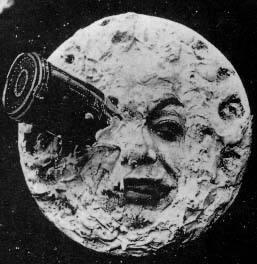
A Paris stage magician turned the new Cinematographe into a machine for fantasy, inventing many of the first special effects and the famous rocket in the eye of the moon.
If the Lumiere brothers pointed the camera at real life, Georges Melies pointed it at the impossible. Between 1896 and the early 1910s he made hundreds of short films full of disappearing people, exploding devils, mermaids and journeys to the stars. Many of the tricks he worked out by experiment are the ancestors of modern visual effects.
From magician to filmmaker
Melies (1861 to 1938) was the son of a wealthy Paris shoe manufacturer. Instead of joining the family business, he bought the Theatre Robert-Houdin, a famous Paris magic theater, in 1888 and staged illusions there.
He saw the Lumiere Cinematographe at one of its first demonstrations in Paris and immediately wanted one. When the Lumieres declined to sell, he obtained a projector from the British pioneer Robert W. Paul, adapted it into a camera and began filming in 1896. His company, Star Film, sold and rented films to showmen across Europe and America.
The stop trick and other inventions
Melies often told a story about how he found his most famous effect. His camera jammed while filming a Paris street; when he projected the footage, a bus seemed to turn into a hearse because the scene had changed during the pause. True or not, the "stop trick" became his signature. Stop the camera, change something in the scene, start again, and an object appears, vanishes or transforms.
He went on to develop or popularize a whole toolkit:
| Technique | What it does on screen | Modern descendant |
|---|---|---|
| Substitution splice | Objects and people appear, vanish or transform | Jump cuts and matched cuts |
| Multiple exposure | Several images, or the same actor many times, in one frame | Compositing |
| Dissolve | One scene melts into another | Standard edit transition |
| Painted sets and miniatures | Fantasy worlds built at small scale | Model work and set extensions |
| Hand coloring | Frames colored individually by hand | Color grading |
In one well-known film from 1900, Melies plays every member of a band at once using multiple exposures. In another, his own head seems to inflate like a balloon, done by moving the actor toward the camera while masking the rest of the frame.
The glass studio
In 1897 Melies built one of the first film studios in Europe at Montreuil, just outside Paris. It had glass walls and a glass roof to let in as much daylight as possible, because film stock of the time needed strong light. Inside, it worked like a theater stage with painted backdrops, trapdoors and machinery for flying scenery. This studio is where most of his films were made, and it set a pattern for the purpose-built studios covered in our guide to the silent era.
A Trip to the Moon (1902)
His most famous film, Le Voyage dans la Lune, follows a group of astronomers who are launched to the moon in a capsule, meet the moon's inhabitants and return to Earth. It runs about 13 to 15 minutes depending on projection speed, which was long for the time, and it was told in a sequence of scenes rather than a single shot.
The image of the capsule landing in the eye of the man in the moon is one of the most reproduced pictures in film history. The film was also widely copied by other companies without permission, especially in the United States, which cost Melies a great deal of money and pushed him to open a US branch to protect his work.
A hand-colored print was found in Barcelona in 1993 in very fragile condition. After years of careful restoration, it premiered at the Cannes Film Festival in 2011.
Decline and rediscovery
By the 1910s, audiences wanted longer narrative films with more realistic acting, and larger companies dominated distribution. Melies' business failed, and many of his original negatives were lost. For years he ran a toy and sweets kiosk at the Montparnasse railway station in Paris.
In the late 1920s, journalists and film lovers rediscovered him. He was honored at a gala retrospective in 1929 and received the Legion of Honour in 1931. Today a few hundred of his roughly 500 films are known to survive, and new prints still occasionally turn up in archives.
Why Melies still matters
Melies proved that cinema could be a medium for imagination, not just a record of reality. Fantasy and science fiction, effects-driven spectacle and the idea of the director as the author of a complete invented world all trace back to him.
Many Melies films are only a few minutes long. Watch one and count the number of times a person or object appears or vanishes. Then compare it with the effects in a modern fantasy film: the methods have changed, but the goal of surprising the audience has not.