The Lumiere brothers and the first film screenings
In December 1895 Auguste and Louis Lumiere charged admission to watch projected films in a Paris cafe basement. Here is how their Cinematographe worked and why it changed everything.
Many inventors built motion picture machines in the 1890s, but the date most often given as the birth of cinema is December 28, 1895. That evening, Auguste and Louis Lumiere showed a program of short films to a paying audience in Paris. The idea of a shared, projected, ticketed screening, the thing you book every time you go to the movies, started there.
Who the Lumieres were
Auguste (1862 to 1954) and Louis (1864 to 1948) were the sons of Antoine Lumiere, a painter and photographer in Lyon, France. The family ran a successful factory making photographic plates, and Louis in particular was a gifted engineer. In 1894 Antoine saw Edison's Kinetoscope peephole viewer in Paris and encouraged his sons to build something better.
The Cinematographe: one box, three jobs
The brothers patented the Cinematographe in February 1895. It was remarkable for being small and versatile:
| Feature | Lumiere Cinematographe | Edison Kinetoscope system |
|---|---|---|
| Functions | Camera, printer and projector in one box | Separate heavy camera and peephole viewer |
| Power | Hand-cranked | Electric motor |
| Portability | Light enough to carry to any location | Camera mostly stayed in the studio |
| Audience | A whole room watching a screen | One viewer at a time |
| Film | 35mm film | 35mm film |
The Cinematographe used a claw mechanism to move the film one frame at a time, and it typically ran at about 16 frames per second. Because it was light, operators could take it outdoors and film everyday life, which became the Lumiere style.
The screening at the Grand Cafe
After private demonstrations to scientists and photographers during 1895, the first public paid show took place on December 28, 1895, in the Salon Indien, a basement room of the Grand Cafe on the Boulevard des Capucines in Paris. The program included ten films, each lasting less than a minute. The audience that first night was small, only a few dozen people, but word spread quickly and lines soon formed outside.
The films were simple "views," mostly single shots of real scenes:
- Workers leaving the Lumiere factory in Lyon
- Blacksmiths at work
- A baby being fed by its parents
- A gardener tricked by a boy who steps on his hose, often called the first filmed comedy
The train at La Ciotat
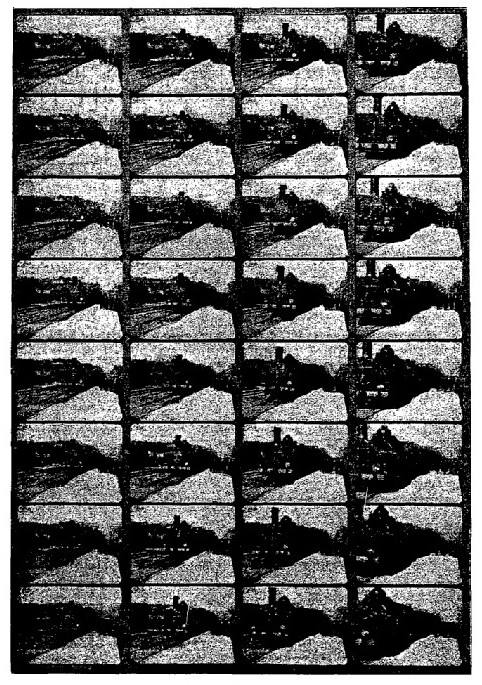
The most famous Lumiere film shows a steam train pulling into the station at La Ciotat on the Mediterranean coast. The camera sits on the platform at an angle, so the locomotive grows from a speck into a large shape filling the frame, and passengers walk past the lens. It was shown publicly from early 1896.
Audiences ran screaming from the room because they thought the train would hit them. There is no reliable contemporary evidence of a panic; the story grew later. Viewers were clearly impressed by the depth and realism, but they were not fooled.
The film is still taught today because it shows real compositional thinking: a strong diagonal line, movement toward the camera and a shot that changes from a wide view to something close to a close-up without any cut.
Sending cinema around the world
The Lumieres did not just sell machines. They trained operators and sent them across the globe to film and to project. Within a year or two, Lumiere programs had been shown across Europe and in cities as far apart as New York, Mumbai, Cairo, Buenos Aires and Tokyo. The operators brought back new footage, and the company's catalogue eventually listed well over a thousand films.
That global network is one reason many countries date their first film screening to 1896, including early shows in Egypt. See Egyptian and Arab cinema for that story.
Why the brothers moved on
The Lumieres soon focused on photography rather than filmmaking. Their next major invention, the Autochrome Lumiere, went on sale in 1907 and was the first commercially successful color photography process. Making films for entertainment passed to people with a showman's instinct, starting with a stage magician who was in the audience at one of those first Paris shows: Georges Melies.
Where to see their legacy today
The family home and the site of the old factory in Lyon now house the Institut Lumiere, a museum and film institute that runs a large annual film festival. The street where the factory workers were filmed leaving is now called Rue du Premier-Film, the street of the first film.
Restored Lumiere films are short enough to watch dozens in one sitting. Watch them as a set and you will notice how often they already use foreground, background and diagonal movement, ideas covered in our guide to cameras and lenses.