The widescreen revolution of the 1950s
When television kept audiences at home, cinemas fought back with screens that were wider, curved and bigger than ever. Here is how Cinerama, CinemaScope, VistaVision and 70mm reshaped the frame.
For its first half century, almost every film was close to square. After the arrival of sound, the industry standard was the Academy ratio of about 1.37:1, meaning the image was only slightly wider than it was tall. In the early 1950s that changed in just a few years, and the wide frame you see in almost every cinema today was born.
Why the frame got wider
The trigger was television. After the late 1940s, TV ownership grew very fast in the United States, and weekly cinema attendance fell sharply. At the same time, a 1948 US court ruling forced the big studios to sell their theater chains, weakening the old studio system.
Studios needed something TV could not offer. Their answers were color, 3D, stereo sound and above all a bigger, wider image. The TV screens of the time had roughly the same shape as the Academy ratio, so going wide was a clear way to make cinema look different.
Cinerama: three projectors, one curved screen
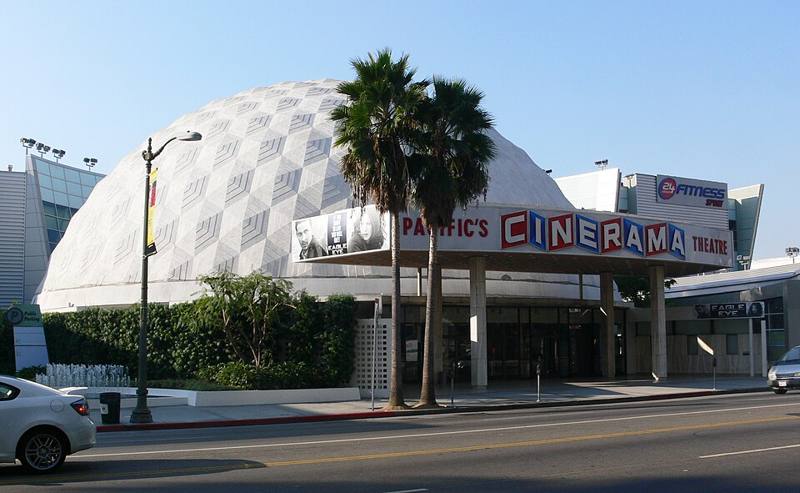
Cinerama opened in New York on September 30, 1952, with a travel showcase called This Is Cinerama. It was filmed with three cameras side by side and projected by three synchronized projectors onto a deeply curved screen, with multi-channel sound. The effect was overwhelming for audiences, who felt as if they were riding a roller coaster or flying over landscapes.
It was also complicated. The joins between the three images were visible, theaters had to be rebuilt, and only a small number of venues could show it. A handful of narrative features were made in three-strip Cinerama before the system moved to single-lens 70mm prints shown under the Cinerama name.
CinemaScope and the anamorphic lens
In 1953 20th Century Fox launched CinemaScope with The Robe. Its trick was the anamorphic lens, based on an earlier invention by the French scientist Henri Chretien. The camera lens squeezes a wide image sideways onto ordinary 35mm film; a matching projector lens unsqueezes it into a wide picture.
CinemaScope was far cheaper than Cinerama because it needed only new lenses, a wider screen and (initially) stereo sound equipment. Many theaters converted quickly. Later, Panavision developed improved anamorphic lenses that became the industry standard. Today's "scope" ratio of about 2.39:1 is the direct descendant.
The format wars
Several competing systems appeared within a few years:
| System | Launched | Studio or company | How it worked |
|---|---|---|---|
| Cinerama | 1952 | Cinerama Inc. | Three cameras and three projectors on a curved screen |
| CinemaScope | 1953 | 20th Century Fox | Anamorphic lens squeezing a wide image onto 35mm |
| VistaVision | 1954 | Paramount | 35mm film run sideways through the camera for a larger, sharper negative |
| Todd-AO | 1955 | Mike Todd and American Optical | 70mm prints on a large curved screen |
| Ultra Panavision 70 | Late 1950s | MGM and Panavision | 65mm negative plus a mild anamorphic squeeze for a very wide image |
VistaVision gave a much finer picture than standard 35mm, even when projected normally. Todd-AO launched with the musical Oklahoma! (1955) and established 70mm projection for big roadshow releases. The widest prints, such as those for Ben-Hur (1959), reached an aspect ratio of about 2.76:1. See our guide to 35mm and 70mm.
Flat widescreen and today's standards
Not every film needed anamorphic lenses. Studios found they could simply mask the top and bottom of the standard frame and project with a shorter lens. In the United States this settled at 1.85:1, while some European countries used 1.66:1 for many years.
The result is the two-ratio system still used in most cinemas:
- Flat, about 1.85:1 for many dramas, comedies and animated films
- Scope, about 2.39:1 for many epics, action films and wide landscapes
Compare every common shape in our aspect ratio table.
3D and the other gimmicks
The same period produced the first big 3D boom. Bwana Devil (1952) launched a short craze for polarized 3D films in 1953 and 1954 before audiences tired of the glasses and projection problems. 3D came back several times, most successfully with digital projection in the late 2000s. See 3D, 4DX and ScreenX.
Widescreen on television
Widescreen created a problem when films were shown on old square TVs. Broadcasters used "pan and scan," cropping the sides and moving the frame around, which cut out as much as 40 percent or more of a scope image. Letterboxing, with black bars above and below, preserved the full composition. Modern 16:9 screens are much closer to cinema shapes, but scope films still show bars at home.
The legacy
The widescreen era also changed how films were staged. Directors learned to fill the wide frame with groups of people and deep landscapes, and the move toward ever larger screens leads directly to IMAX, which began in the early 1970s.
When choosing a seat for a scope film, sit a little farther back than you would for a flat film so the whole width fits comfortably in your view. More in seats and formats.