Before cinema: magic lanterns and moving pictures
Long before the first film screening, people projected painted glass slides, spun optical toys and photographed galloping horses. Here is how those inventions led straight to the movies.
Cinema did not appear out of nowhere in 1895. It was the end point of more than 200 years of experiments with projected light, painted images and the way the human brain blends separate pictures into smooth motion. Every element of a modern screening, from the darkened room to the bright beam over your head, had a pre-cinema ancestor.
The magic lantern
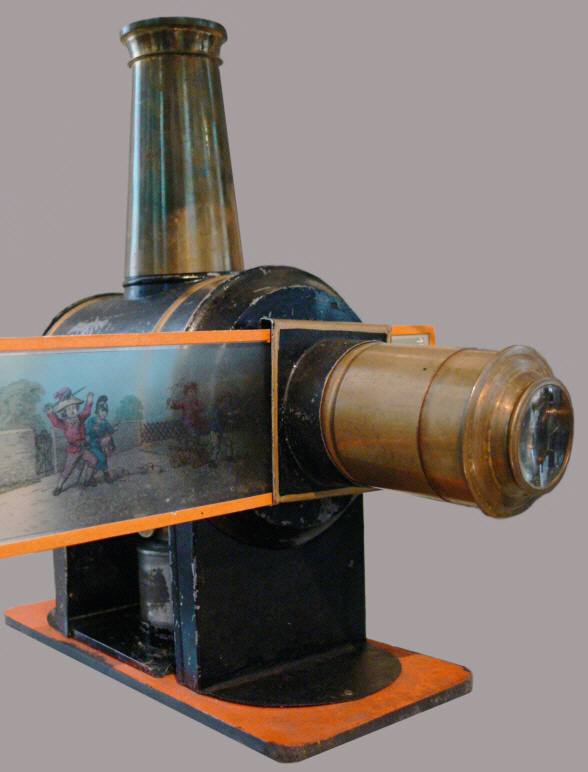
The magic lantern was the first practical image projector. Versions were described in the mid-1600s, and the Dutch scientist Christiaan Huygens is usually credited with one of the earliest working designs around 1659. The principle is the same one a cinema projector still uses: a light source, an image on glass, and a lens that throws an enlarged copy onto a wall or screen.
Early lanterns burned candles or oil, so the pictures were dim. Brighter sources arrived in the 1800s, especially limelight, made by heating a block of lime in a gas flame (the origin of the phrase "in the limelight"). By the late 19th century, lantern shows were a big business. Traveling showmen, lecturers and schools used them for:
- Travel talks with photographs of distant cities
- Comic stories told across a sequence of slides
- Science lessons on astronomy and natural history
- Spooky entertainment, such as the "phantasmagoria" shows staged in Paris in the 1790s
Clever slides even created movement. Some had a second sheet of glass that slid or rotated, so a figure could nod its head or a windmill could turn. Two lanterns pointed at the same screen allowed "dissolving views," where one scene faded into another, an effect that later became a standard editing transition.
Optical toys and the illusion of motion
In the 1800s, inventors found that a series of slightly different drawings, shown in quick succession, looks like a single moving picture. A wave of optical toys turned this into home entertainment.
| Device | Year introduced | How it worked |
|---|---|---|
| Thaumatrope | 1825 | A card with a picture on each side; spinning it merged the two (a bird appears in a cage) |
| Phenakistiscope | 1832 | A slotted spinning disc viewed in a mirror, devised by Belgian physicist Joseph Plateau |
| Zoetrope | 1834 | A slotted drum with a strip of drawings inside; several people could watch at once |
| Praxinoscope | 1877 | Emile Reynaud replaced the slots with mirrors for a brighter, clearer image |
| Theatre Optique | 1892 | Reynaud projected long hand-painted picture strips for paying audiences in Paris |
Reynaud's Theatre Optique is worth remembering: years before the first film screening, he was projecting animated stories with music for paying audiences at the Musee Grevin in Paris. In a sense, animation came before live-action cinema.
Photography learns to capture motion
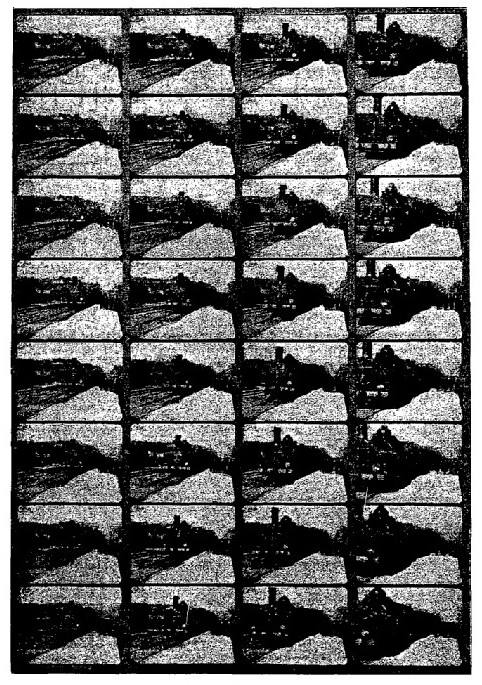
The next step was to replace drawings with photographs. In 1878, the photographer Eadweard Muybridge used a row of cameras triggered in sequence to photograph a galloping horse in California, showing that all four hooves leave the ground at once. His sequences could be shown in motion with his zoopraxiscope, a projecting version of the spinning-disc toys.
In France, the physiologist Etienne-Jules Marey built a "chronophotographic" camera in the early 1880s that captured several images in rapid succession from a single position. Others raced to do the same on a strip of flexible material. Two things made that possible:
- Celluloid roll film. In 1889 Eastman's company introduced transparent flexible film, strong enough to run through a machine.
- Intermittent movement. A mechanism that pulls the film forward, holds each frame perfectly still for an instant, then pulls again. Every film camera and projector since depends on it.
Louis Le Prince filmed short scenes in Leeds, England, in 1888, which are among the oldest surviving motion pictures. He disappeared in 1890 before he could present his work publicly.
The Kinetoscope: movies through a peephole
Thomas Edison's laboratory, with William Kennedy Laurie Dickson doing much of the engineering, developed the Kinetograph camera and the Kinetoscope viewer. The first commercial Kinetoscope parlor opened in New York in April 1894. Customers paid to look into a wooden cabinet, one person at a time, at a loop of film lasting well under a minute.
The Kinetoscope also fixed a detail you can still see today: Dickson's film was 35mm wide with perforations along both edges, the ancestor of the standard 35mm format.
The missing piece was projection. A peephole served one viewer; a screen could serve a whole room. Within about 18 months of the first Kinetoscope parlor, inventors in several countries were projecting film for audiences, and the most famous of them were two brothers in Lyon. Continue with the Lumiere brothers.
What survives of pre-cinema today
Pre-cinema is not just a museum topic. Its ideas are everywhere in modern film:
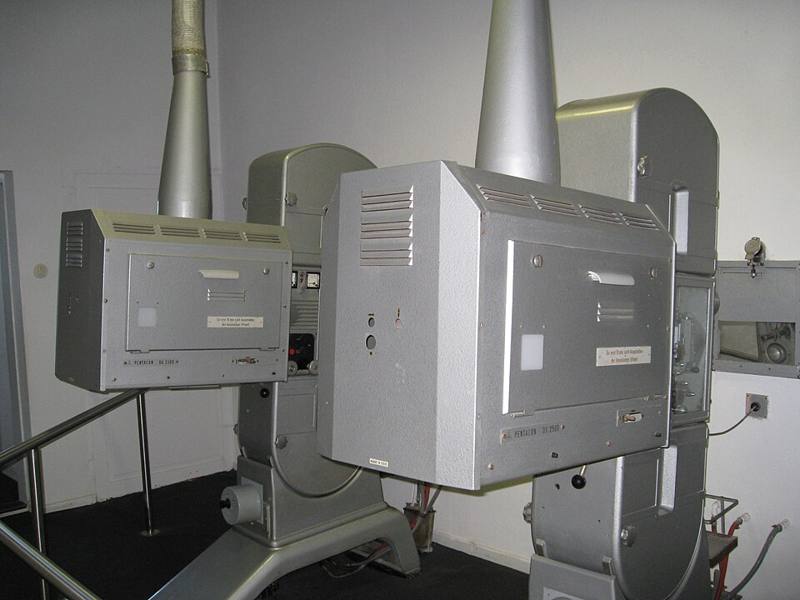
- Projection. The lantern's lamp, image and lens became the cinema projector. See how projection works.
- Animation. The zoetrope's strip of drawings is the direct ancestor of hand-drawn animation, frame by frame.
- Transitions. Dissolving views became the dissolve between scenes.
- Showmanship. Lantern lecturers who narrated, added music and timed their reveals were rehearsing the cinema experience.
Film appears to move because of how the brain processes rapid image sequences. Early silent films often ran at roughly 16 to 20 frames per second, and sound film settled on 24. Read more in our guide to frame rates.